
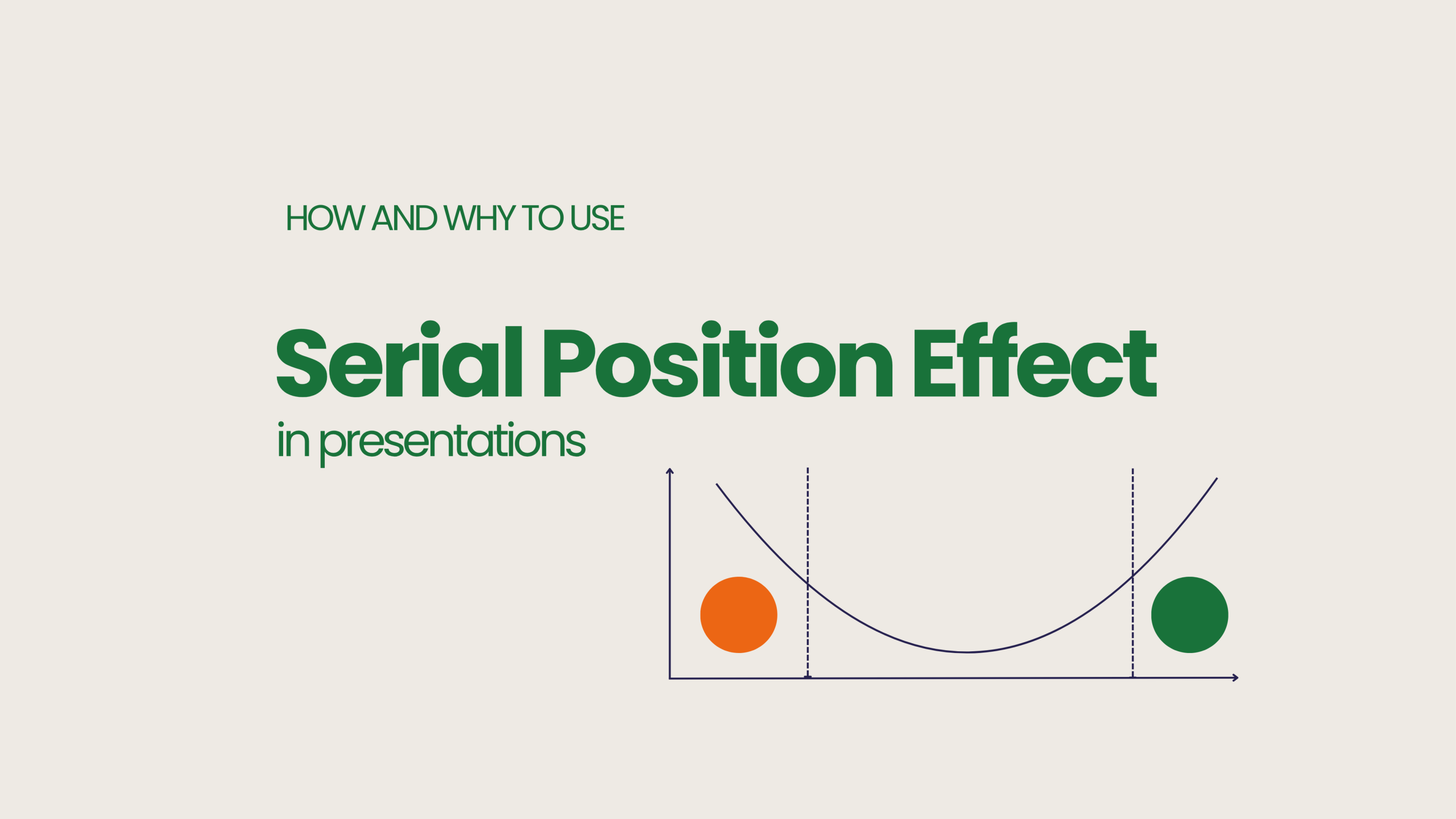
Use the Serial Positioning Effect in presentations
At 3storybuilding, we love simple hacks that take your presentation to the next level.
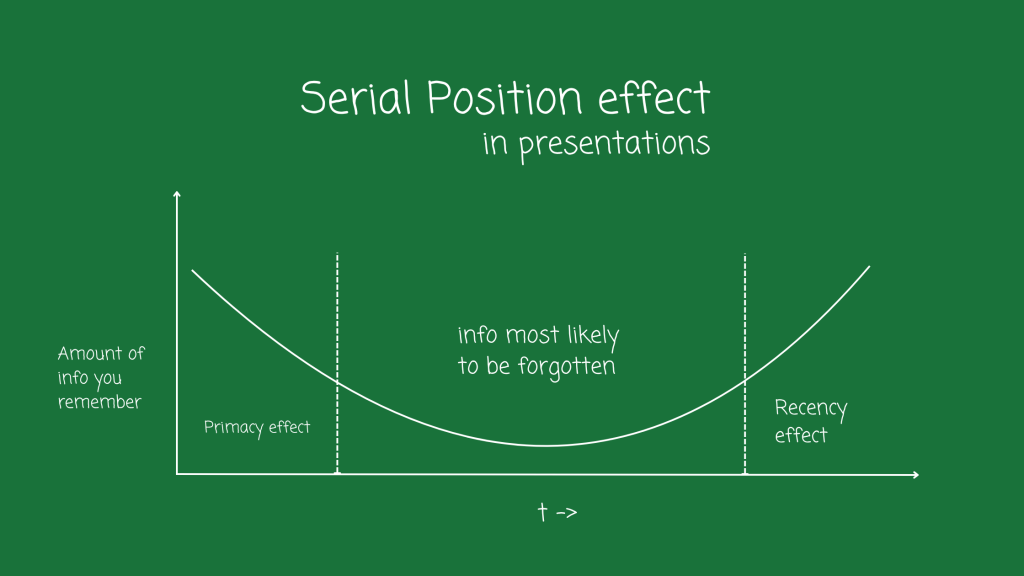
One of our personal favourites is the serial positioning effect. By pausing to consider where you present the most important information, you ensure it sticks. Information at the beginning and end of your presentation is remembered best. So, share what’s truly important at those two points.
The serial position effect is rooted in basic psychology
Psychologists have always been curious about how people learn. With their knowledge and tips, they improve education. And with their insights, you too can directly improve the impact of your message.
Primacy effect – the beginning counts
They discovered the primacy effect. At the beginning of your presentation, your audience is still fresh and focused. They have the attention and time to properly store the first things in their memory. Later, so much new information comes along that that first impression, so to speak, remains paramount. You remember it.
Recency effect – the ending counts
The information at the end of your presentation remains fresh in your short-term memory for a while. When your audience recalls what they heard or saw, that ending is still active in their minds. Earlier information has already faded somewhat. This is called the recency effect.
Why should you use the serial effect while presenting?
After all, you didn’t go to great lengths to find clear answers to your client’s questions for nothing. The most important results of your research deserve attention, as do your conclusions and recommendations. There’s nothing more frustrating than a yawning audience or questioning looks afterward. You can prevent this by presenting the most important information in the right place.
Set the tone with your start
If you think about it, most TED Talks begin with a single, powerful opening line to immediately grab attention. That first sentence sets the tone for the entire talk. Speakers even tailor their opening line to their message: a touch of humor if their talk is lighthearted, or perhaps a quote from a well-known figure in their field. The possibilities are endless, but most importantly: be mindful of what you’re doing. Your opening sets the tone for everything that follows.
A powerful conclusion
So, start with something that immediately grabs attention and clearly defines the outcome of your presentation. You should also conclude your presentation with your main message, a clearly formulated conclusion, and/or a clear call to action.
How does the serial position effect look in practice?
You’re probably craving a practical example right now. Fear not, here’s an example for a catchy opening, and one for a memorable closing!
1. A captivating start to a presentation
Don’t start with a chart or table, but with a story, question, or provocative observation that gives meaning to your data. Then, later on, show the numbers as evidence of what you just said.
“Picture this: it’s Monday morning, and one in three employees logs in with a sigh. Not because the work is too hard, but because they feel unheard. Our data uncovers why, and how you can change that.”
Notice how this grabs attention, creates clarity, and sets expectations? Three sentences and you’re reminded why strong data storytelling works.
2. Add a final burst of adrenaline at the end of your story
How do you end? Always on a high note! Clearly repeat the core message. Emotionally close the circle by referring back to the beginning. And with a strong call to action, you give a first push toward the next step.
“One in three employees starts the week without energy. The data tells us why. If we respond to those signals and empower people to structure their own work, we’ll boost both enjoyment and engagement; the foundation of a thriving organisation.”
Well, this is what we call a string of powerful sentences! The example is similar to the end of a pitch. And that’s no coincidence. With strong language, you give one last shot of adrenaline and provide the energy to take action.
Start strong and end even stronger
People remember best what they first heard and what they last heard. Anything you say in between is naturally remembered less well. That’s why your beginning and end count twice.
With a strong start, you set the foundation. With a powerful ending, you make it stick.
If your beginning and end are solid, all you need to do in between is provide evidence!
Want help with that? Get in touch with us!
